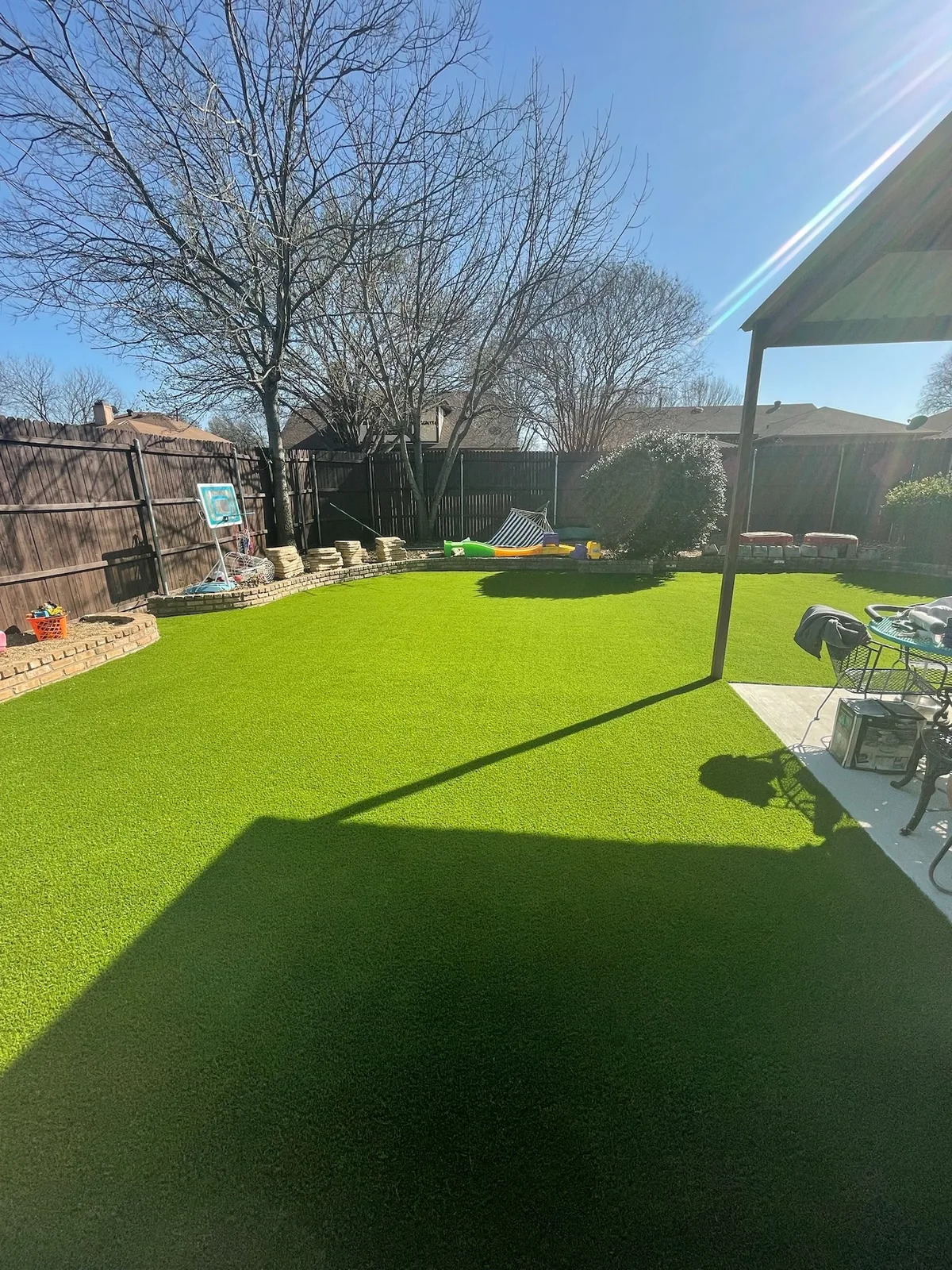
Short answer
On Frisco clay, artificial turf generally goes on a compacted crushed stone base graded toward an outlet. The USDA rates Houston Black clay, the signature soil of the Blackland Prairie, as very slowly permeable with high shrink swell potential. Soils vary from lot to lot, but turf laid straight on clay like that tends to move.
For artificial grass installation on clay soil, DFW homeowners should look hardest at what goes under the turf. A backyard here can hold puddles after a storm and then bake into a cracked slab by August. Blackland Prairie clay behaves that way across much of this area, though soils vary, so the base gets decided yard by yard. A thin base on raw clay can look fine at first and then start to move after a summer or two. Two quotes can name the same turf and still land far apart, and what goes under it is often why. Our artificial grass Frisco page shows the services and typical prices.
Why does Frisco's clay heave, crack and hold water?
Frisco and its neighbors sit near the north end of the Blackland Prairie, a belt running from north of Dallas to San Antonio. The signature soil of that belt is Houston Black clay, which the USDA's official series description rates as very slowly permeable with high shrink swell potential. A USDA profile of the soil, hosted by the Texas Water Development Board, adds that water enters quickly when the ground is dry and cracked, and very slowly once it is moist. Neither one names your street, so a county soil survey or a look at your own ground is the way to know what you have.
You can picture how that plays out in a yard. A spring storm runs into the cracks, the clay swells shut, and later rain sits on top. Then summer dries it all out and the ground splits again. A surface laid straight on that ground tends to move with it, and seams and edges can suffer.
The Texas Department of Licensing and Regulation's bulletin on foundations over expansive soils makes a similar point for houses. It says water must drain away from the house on all sides, and that surface drainage, plant choices and sprinkling practices are important in minimizing swings in soil moisture. That bulletin is written for builders of houses, and it is relevant here because a turf base sits on the same kind of ground.
What comes out of the ground, and what goes back in?
The old grass and its roots come out, along with enough soil to make room for the base. How much depends on the yard, and a spot that already holds puddles may need more. When you compare quotes, it is fair to ask each installer what they plan to remove and where it goes.
The base is crushed stone, spread in layers and compacted, with a gentle slope so water heads away from the house. Compaction has a big say in whether the surface stays flat, and loose stone tends to settle unevenly, so ask how each layer gets compacted.
A geotextile fabric between the clay and the stone is a common option to ask about. It is generally used to keep the stone from working down into wet clay and the clay from working up into the stone. Some installers call it a weed barrier, and it may help with that too. No base can fully stop clay from moving, though a well built one generally gives the surface a much better chance of staying flat and draining.
Where does the water go under artificial turf?
The water needs somewhere to go. On clay it tends to soak in very slowly, so the base is generally graded toward an outlet such as a lawn edge, a bed, an area drain or a swale, and away from the house and the neighbor's fence. A gentle, consistent slope is usually enough. If water keeps standing, the slope probably needs a second look.
Most landscape turf drains through a perforated or flow-through backing, and the infill brushed into the fibers passes water as well. Products differ, and a dense backing or the wrong infill can slow water even over a good base, so ask what each quote includes. Flow-through backing is worth asking about for dog areas, and our Frisco pet turf for dog runs and worn yards page covers why rinse water needs a way down and out.
Pool surrounds are the other place where grade really matters. Splash and wet feet put water on a narrow strip, and that strip generally needs to pitch away from the deck and the house while still looking level. Our Frisco pool surround turf page shows how that is set up.
When does a yard need a French drain?
Plenty of yards can get by without one, since a compacted base with a fall to a sensible outlet can often handle ordinary rain. A French drain is a gravel trench with a perforated pipe inside, and it tends to suit the yard that collects water from somewhere else, like a lot that sits below its neighbors, a downspout that empties into the back corner or a fence line where two yards' runoff meets. In those cases the trench generally runs under the base to a point where it can drain out at the surface or tie into an area drain, and the turf goes over it.
All of this can move a quote. Our turf typically runs $10 to $12 per square foot installed, and a yard that needs extra excavation, more stone or a drain can land toward the top of that range or above it. Treat it as a ballpark until you have a written quote for your yard, and see what turf costs in Frisco for what moves the number. A freshly graded lot in Little Elm and an older yard in Plano can need very different base work, and your written quote will reflect what your yard needs.
Frequently Asked Questions
Can I just lay artificial turf over dirt in Frisco?
We wouldn't, especially on clay. Houston Black clay, the signature soil of the Blackland Prairie, swells when wet and shrinks when dry, and the surface can crack in a hot summer, so turf laid directly on it tends to move with it. A compacted crushed stone base gives the surface a much better chance of staying flat.
How is the base built under artificial turf on clay soil?
It depends on the yard. Generally the old grass and roots come out along with enough soil to make room for crushed stone, which goes back in compacted layers with a gentle slope. Yards that already hold water or need a drain can take more work, so tell us what you are seeing when you ask for a quote.
Does artificial turf need a weed barrier on clay?
A geotextile fabric between the clay and the stone is a common option to ask about, mainly to keep the two layers separate so the base holds its thickness. It may also slow some growth from below, though tough weeds like nutsedge can get through fabric. Seed landing on top is a separate maintenance matter.
Will artificial turf fix a backyard that floods after storms?
It can help if the flooding comes from slow clay, since a graded stone base gives water somewhere to go. If water arrives from a neighbor's lot or a downspout, the base alone may not solve it, and a French drain or an area drain may belong in the plan. We would start by finding where the water comes from.
Ready to Get Started in Frisco?
Frisco Artificial Turf Pros serves Frisco and the surrounding area. Tell us about the yard and we'll write up a quote.